
Building Stories Review: The Art of Slowing Down

Prior to my Writing 101 experience, I would rush through essays as quickly as possible. Free Response Questions on AP exams conditioned me to prioritize getting ideas down on paper in a timely manner above all else. What little revision I added to my essays were to fix spelling or small grammatical errors. The use of templates to create structured arguments in Writing 101 only fueled my rushing problems. Cathy Birkenstein & Gerald Graff address writers like me by stating “… in most cases when students do merely superficial revisions, it’s not because they are indifferent or lazy,” claiming instead that “They aren’t sure what a good revision looks like.” (Birkenstein and Graff 149). Although the most difficult, learning to take a step back and critically read through my writing became the most effective method to improving my revisions. In this essay, I will provide specific examples of the topics in Writing 101 which demonstrate the importance of slowing down when making impactful revisions to template writing.

A large portion of Writing 101 was dedicated to learning how to use templates which prompted writers to add necessary criteria to a pre-built sentence for an argument. The originality came when the templates were blended by replacing the conventional writing with my own transitions and phrases. At the beginning of the course, I struggled with getting the template writing out of my work. In my first essay, I tackled the ethics of AI use in academic writing, critiquing a scholar warning his audience against the reliance of formulaic AI writing. I stated “ Though I do disagree with much Kirschenbaum [the scholar] states, I fully endorse his conclusion that the overuse of AI tools in writing will result in an increase of mundane, uninspiring works.” Elaborating with “On the other hand, I believe that AI, understood correctly, as a remixer to what has already been written, makes for a powerful tool in the arsenal of a writer looking for fresh perspective in their writing.” Both sentences clearly use templates with no revision making for unoriginal writing with clutter and filler words. Later in the semester I learned how to start with a template, but then blend the formulaic structure to the rest of my essay with modified transition words and phrases. My third essay details the inner workings of the FBI’s data collection system and how it connects to mass incarceration. I assert “The War on Crime was likely paid for by the additional funding the FBI received through the inflation of crime statistics illuminating the connection between the mass incarceration of minority groups, and the FBI’s misrepresentation of crime data with the [Uniform Crime Reporting Program].” I originally wrote the sentence with a template but proceeded to remove the generic structure to more successfully highlights the connection between FBI funding and mass incarceration. The process took considerably longer, but the blended template more effectively supports the central argument with my own words. My writing greatly improved when I took a step back, thought through what I wanted to communicate, and then transitioned those thoughts into words.

The primary issue I had with slowly revising my writing, word for word, was becoming too critical and thus unable to produce any content at all. On my second essay, I spent hours fearful of writing unacceptable work after the criticism I received on the first essay. Scholar Ann Lamott addresses this common issue with her “shitty first draft” method. She claims “almost all good writing begins with terrible first efforts. You need to start somewhere. Start by getting something- anything down on paper” (Lamott 25). By beginning my drafts without overthinking, I conquered my fear of writing before going back and thoroughly revising my work. Part of the process was understanding, as Lamott states, “writing is not rapturous. In fact, the only way I can get anything written at all, is to write really, really shitty first drafts” (Lamott 22). I plan to implement this strategy moving forward to not only save time, but to ensure all my thoughts land on paper, leaving only the most important topics for the final draft. Silencing the fear of drafting has proven difficult and will be an aspect of writing I will always struggle with and seek to improve upon.

Beyond sentence structure and drafting, I have enhanced my ability to use outside evidence in a way which supports but does not overshadow my central arguments after using a template. My first essay featured an example of how AI collects patterns in human writing off the internet to demonstrate how AI uses pre-existing text as opposed to synthesizing original prompts. I wrote: “I Asked the AI tool, Chat GPT to write a speech based off Martin Luther King Jr’s writing style. The essay produced was a fiery speech promoting equality and justice for all. powerful metaphors, rhythm, and repetition were littered throughout the essay as if it were written by MLK  himself.” Instead of supporting my claim that generative AI should remain in society, the evidence worked against me by scaring away readers who mistrusted AI’s ability to copy human speech. I learned later in the semester to carefully read through my work and ask myself if my evidence supported the main claim. The most helpful peer feedback I received throughout the semester was the sections where my writing had no clear correlation between the claim and the supporting evidence. To stay aware of this move in future writing, I must remind myself to slow down my revision process and thoroughly think through how my evidence connects to the rest of the writing the same way I blend templates.

I share the same perspective as Graff and Birkenstein, who support template writing to ensure all aspects of an argument feature in an essay. I would elaborate further that the strategy only works if writers are whiling to make careful revisions afterwards to strengthen their argument. Moving forward, the art of slowing down will be crucial in the abstract writing I will synthesize in Philosophy classes. Additionally, As I delve deeper into the natural sciences at Davidson, I plan to hone my ability to effectively represent the hypotheses I feature in papers with meticulous revision. The key takeaway from my writing 101 experience was learning to invest the extra time and stress associated with tedious revision to developed clear and thoughtful writing.

Link to Annotated Final Essays:

https://docs.google.com/document/d/1q5i7Y22SJFb6EcGTkRyFth8m7oO_fG2uG7NwDJivu3I/edit?usp=sharing

Citations:

Birkenstein, Cathy. Graff, Gerald, They Say I Say. Chicago, Illinois, Norton and Company, 2021

Lamott, Anne. “Shitty First Drafts”. Bird by Bird. Edited by Linda Taylor, Anchor Books, 1994, pages 20-27

Essay 3 Revised: How the FBI is Linked to Mass Incarceration

For decades, the US Federal Bureau of Investigation (FBI) has manipulated crime statistics to increase funding for police forces. The 1970s marked the beginning of the FBI’s new Uniform Crime Reporting Program (UCR) which collected crime data onto one federalized network providing themselves the power to control crime statistics in America. The consequence is an overfunded police force that has skyrocketed incarceration rates particularly in minority dominated, low-income areas (Maltz 5). Regardless, Others view the issue of mass incarceration as a plot to keep racism alive in America. The primary disagreement in the debate is whether the UCR or racist political policy links to mass incarceration. Michelle Alexander asserts that the mass incarceration of minority groups is due to policies which indirectly cause racial injustice such as the War on drugs to create a racially biased justice system. In contrast, Elizabeth Hinton asserts that the FBI unintentionally increased incarceration rates using the UCR program to justify larger executive spending which increased incarceration rates. In this essay, I will examine the methods in which the FBI began collecting violent crime data in the 1970s to argue that mass incarceration in America is due more so to bureaucratic corruption rather than the facilitation of a political system which supports racial segregation.

Those who assert that mass incarceration is down to an intentionally racist political system can be represented by Michelle Alexander through her thought-provoking analogy the “New Jim Crow”.  The analogy makes the argument that the primary reason minority groups in America are disproportionately imprisoned is due to a hidden political system threatening minority rights, much like the original Jim Crow laws. She supports this theory explaining “… People who have been incarcerated rarely have difficulty identifying the parallels between these systems of control [US justice system and Jim Crow]” (Alexander 5). She places an emphasis on how the US justice system was purposefully built to hinder those leaving the penal system rather than focusing on criminal correction (Alexander 111). Since minority groups are incarcerated at significantly higher rates proportional to population, there are consequently more minorities with limited rights post correction. Although critiques can be made to Alexander’s “New Jim Crow” analogy, I acknowledge that America’s racist justice system is due to flawed aspects in America’s bureaucracy. I seek to specify that these flaws were put in place not directly with racial segregation in mind, but rather indirectly through program funding loopholes. 

Data collected by the UCR from the 1970s can be used to demonstrate how the FBI began misrepresenting violent crime data for their own personal gain. After its creation in 1908, the FBI pushed for state-run criminal justice systems to provide arrest reports for a federal database which could present crime statistics publicly (Maltz 11). In 1970, three states submitted their arrest reports, but by the end of the decade, this number rose to 48 states (Maltz 12). To handle the enormous amount of data, the FBI created the UCR program to streamline the process of data collection. While computers were able to efficiently collect millions of crime reports across the nation, Maltz writes that “more and more of the crime statistics reported by the police have not been based on crime counts but on imputed crime counts” (Maltz 12). Essentially, while violent crime arrests laid in the six figures, crimes recorded by the police without an arrest as well as reported victimizations were included under violent crime: imputing a total violent crime count closer to 3.5 million in the UCR (Maltz 23). By overinflating the crime statistics with unofficial reports, the FBI assembled the data necessary to request higher funding accounting for the supposed increase in violent crime. Rather than attempting to accurately represent violent crime data in America, the FBI used the UCR to gain funding and power.  Maltz continues to explain how by the end of the decade, UCR data was used exclusively to allocate federal executive funds. Whenever the FBI could show an increase in crime rates, their budget automatically increased (Maltz 35). The evidence above supports my conclusion regarding mass incarceration resulting from an overly funded bureaucracy and police force running off a system which rewards arrest instead of correction.  

While UCR data supports the idea that the FBI began inflating violent crime reports in the 1970s to receive more funding, the full story requires more information to show how the data relates to the mass incarceration of minorities. Elizabeth Hinton adds historical context to Maltz’s data analysis, asserting that the transition in American policy to the War on Crime in the late 1970s led to the increase in incarceration of minorities due to over policing in lower income areas. She writes “politicians and officials have explained mass incarceration as a seemingly natural policy response to a surge in criminality and violence” (Hinton 8) and contrasts this statement by writing  “but scholars have pointed to the ways in which mass incarceration and the justice disparities within it expressed changes in law, budgetary allocations for crime control, and punitive practices at all levels of government” (Hinton 8).  Hinton demonstrates a clear split in rhetoric between political officials who blame mass incarceration on the increasing crime shown by the UCR, while scholars outside the government see mass incarceration because of over policing due to the UCR. She urges her readers to explore how injustice in the U.S. justice system could result from corrupt budgeting policies instead of focusing exclusively on racial bias. Hinton also builds off Alexander’s work in this way. While Alexander asserts the War on Drugs in the 1980s was used to carry out the “New Jim Crow”, Hinton elaborates that the previous 1970s War on Crime led to rising incarceration rates due to over policing in low-income areas with higher minority populations. The War on Crime was likely paid for by the additional funding the FBI received through the inflation of crime statistics illuminating the connection between the mass incarceration of minority groups, and the FBI’s misrepresentation of crime data with the UCR. 

By focusing specifically on violent crime statistics in America, the connection between the FBI’s overinflation of crime data and the mass incarceration of minorities becomes even more apparent. James Forman contends that Alexander’s “New Jim Crow” analogy holds power in bringing light to the issues of mass incarceration but can take away portions of context that make up the problem. The “New Jim Crow” idea never considers non-violent vs violent crime instead labeling all prisoners equal in the severity of their crimes. He writes against the analogy stating that it “generates an incomplete account of mass incarceration-one in which most prisoners are drug offenders, violent crime and its victim’s merit only passing mention, and white prisoners are largely invisible” (Forman 34). Forman promotes the important distinction to his audience as to how non-violent vs violent crimes are changing in America and how this relates to the incarceration of minorities. Connecting this point of Maltz’s data, The FBI’s overinflation method revolves around imputing unofficial violent crime reports which appear most prominently in lower income urban areas with higher proportions of minority groups. This further supports my argument that the discussion of mass incarceration in America must be looked upon as a policy issue rather than a social justice one. While I fully endorse the fact that minority groups are disproportionately imprisoned at higher rates in America, I contend flaws in America’s bureaucracy are to blame rather than racist politicians plotting a “New Jim Crow.”

Analyzing how minorities in legislative offices vote towards FBI budgeting and judicial reform further solidifies how the problems which cause mass incarceration lie in the political system itself. Forman adds another layer to the discourse by acknowledging the African American justices and politicians in Washington D.C. who vote for policies that determine the FBI’s budget. He states, “Washington, D.C. is the nation’s only majority-black jurisdiction that controls sentencing policy” (Forman 38) and follows with “there is little evidence that D.C. officials have sought more lenient criminal policies, only to be overruled by Congress. To the contrary, local elected officials have recently pushed for tougher criminal penalties” (Forman 41). This evidence suggests mass incarceration results not from politics, but from corrupt bureaucratic systems such as the FBI’s UCR. While D.C. cannot represent the entire U.S., I still assert that the representation of minorities in D.C. supporting law enforcement in policy demonstrates how the causes of mass incarceration in America could be more than racial bias in the legislature.

               The debate ultimately comes down to whether the broken incarceration system in America is due to the rise of the “New Jim Crow” or if the FBI’s manipulation of violent crime data to increase budgeting has indirectly created the issue. There is no argument regarding the over policing of low-income areas with high percentages of minorities leading to increased levels of incarceration. I contend the best way forward is to collect violent crime data separate from the FBI to determine and regulate budget. An independent data collection agency dedicated to fairly representing crime data would allow legislation to more accurately gauge the FBI’s budget. This solution could potentially minimize mass incarceration by allowing the executive to focus on criminal correction. Suggestions aside, the essence of the mass incarceration discussion remains a systemic issue rather than a social justice issue.

PLEDGE: Robby Votta

“On my honor I have neither given nor received unauthorized information regarding this work, I have followed and will continue to observe all regulations regarding it, and I am unaware of any violation of the Honor Code by others.”

* No form of AI was used in the making of this essay

Citations:

Alexander, Michelle. The New Jim Crow: Mass Incarceration in the Age of Colorblindness. 10th ed., New Press, 2020.

Forman, James Jr. “Racial Critiques of Mass Incarceration: Beyond the New Jim Crow.” Hein Online, Harvard Law School Library , 29 Nov. 2011,

Hinton, Elizabeth. “Introduction: Origins of Mass Incarceration” From the War on Poverty to the War on Crime, Edited by the Harvard University Press, 2016, pages 1-28

Maltz, Michael D. “Bridging Gaps in Police Crime Data – Bureau of Justice Statistics.” Bridging Gaps in Police Crime Data, Bureau of Justice Statistics, Sept. 1999, bjs.ojp.gov

Essay 3 Draft

               It is clear to Scholars that the Federal Bureau of Investigation (FBI) manipulate crime statistics to increase funding for police forces consequently increasing incarceration rates. So why do others view the issue of mass incarceration as a plot to keep racism alive in America? One sticking point in the debate is how the FBI unified state-collected crime data into one federalized network called the Uniform Crime Reporting program (UCR) starting in the 1970s. Scholars disagree as to whether mass incarceration is linked to the UCR or racist politicians wishing to decrease rights in minority demographics. Michelle Alexander argues that the mass incarceration of minority groups is due to policies which push racial control such as the War on drugs to create a “New Jim Crow”. In contrast, Elizabeth Hinton asserts that the increase in mass incarceration was caused by the FBI using the UCR program to overinflate crime rates to receive more funding. Underlying this discrepancy are conflicting assumptions over race versus economic policy. In this essay, I will examine the methods in which the FBI began collecting violent crime rate data in the 1970s to argue that the rise of mass incarceration in America is due more so to bureaucratic greed, rather than the Facilitation of a political system which supports racial segregation.

Michelle Alexander jump started the conversation of Mass Incarceration in 2010 with her thought-provoking analogy the “New Jim Crow”. She argued that the primary reason minority groups in America were disproportionately imprisoned, was due to an hidden political system directly aimed at taking away the rights of African Americans and other minorities, much like the Jim Crow laws of old. She supports this theory explaining “… People who have been incarcerated rarely have difficulty identifying the parallels between these systems of control [US justice system and Jim crow laws]” (Alexander 5). She contends the US justice system was purposefully built to hinder those leaving the penal system rather than functioning as a correction center (Alexander 111). Since African Americans are incarcerated at significantly higher rates in relation to population, there are consequently more African Americans with limited rights post release. Although I am about to pick apart Alexander’s “New Jim Crow” analogy, I cannot deny America’s racist justice system is due to aspects of the laws politicians have enacted, however I will argue that these systems were put in place not directly with racial segregation in mind, but rather, program funding.     

If I am going to argue that America’s mass incarceration problem is due the FBI’s system of collecting data, and not the “New Jim Crow”, I must first explain how the method in which the FBI represents crime from a national perspective. Since its creation, the FBI began pushing for state and local criminal justice systems to provide arrest reports to create a national database to present crime statistics publicly for social scientists and politicians alike. In 1970, just three states submitted their arrest reports, but by the end of the decade, this number rose to 48 states (Maltz 12). To handle the gargantuan amount of data, the FBI created the UCR program to streamline the process of data collection. While the computers used on the UCR were able to accurately collect millions of crime reports across the nation, Maltz states that “more and more of the crime statistics reported by the police have not been based on crime counts but on imputed crime counts” (Maltz 12). Essentially while violent crime arrest counts laid in the six figures from the 70s to the 90s, crimes recorded by the police without an arrest along with victimizations reported by the police were also included under violent crime creating a total violent crime statistic closer to 3.5 million. By overinflating the crime statistics in this way, the FBI could have presented this data to America’s Legislation requesting higher funding to account for the supposed increase in violent crimes. Maltz states that UCR data is also directly used to allocate federal executive funds, so when the FBI can show an increase in crime rates, their budget increases (Maltz 35). It is for this reason that I believe the increase in mass incarceration amongst minority groups is due to an overly funded executive running off a system that rewards arrest rather than seeks to prevent it.  

At this point, many are undoubtably wondering how the FBI overinflating their crime statistics to increase their budget is linked specifically to mass incarceration of African Americans and not simply US citizens. Elizabeth Hinton adds on to Maltz’s work from the Bureau of Justice Statistics to assert that the transition in American policy from the War on Poverty in the 1960s, to the War on Crime in the 1970s was what led to the increased in mass incarceration of minorities. She writes “Politicians and officials have explained mass incarceration as a seemingly natural policy response to a surge in criminality and violence among specific sects of the citizenry, but scholars have pointed to the ways in which mass incarceration and the justice disparities within it expressed changes in law, budgetary allocations for crime control, and punitive practices at all levels of government” (Hinton 8). Hinton argues that America’s shift from simply helping impoverished citizens find their feet, to increasing law enforcement in lower income urban areas with the higher levels of crime and minorities has more to do with the flawed system of FBI budgeting rather than America’s legislature indirectly attempting to limit the rights of minority groups. Hinton also indirectly builds off Alexanders’s work in this way. While Alexander asserts the War on drugs in the 1980s was used to carry out the “New Jim Crow”, Hinton argues that the 1970s war on crime, on which the war on drugs was built off, was a result to the corrupt executive of the time which was rewarded for arrest rather than criminal correction.

A scholar who can add to this conversation is James Forman who agrees that Alexander’s “New Jim Crow” analogy holds power in bringing light to the issues of mass incarceration but takes away portions of context that make up the whole problem. He writes “Proponents of the analogy focus on those aspects of mass incarceration that most resemble Jim Crow and minimize or ignore many important dissimilarities. As a result, the analogy generates an incomplete account of mass incarceration-one in which most prisoners are drug offenders, violent crime and its victims merit only passing mention, and white prisoners are largely invisible” (Forman 34). If Forman assertion is valid, the way I believe it is, the discussion of mass incarceration in America needs to be looked upon as a policy issue rather than a social justice one. While I fully endorse the fact that minority groups are disproportionally imprisoned in America, I contend flaws in America’s bureaucracy are to blame rather than racist politicians plotting a “New Jim Crow.” Forman adds another layer to the discourse acknowledging the African American justices and politicians in Washington DC who vote for the policies which determine FBI budget justice system reforms. He states “Washington, D.C., is the nation’s only majority-black jurisdiction that controls sentencing policy. The district is 51% African American.” (Forman 38) and followed with “There is little evidence that D.C. officials have sought more lenient criminal policies, only to be overruled by Congress. To the contrary, local elected officials have recently pushed for tougher criminal penalties” (Forman 41). Unless minority leaders in DC are a part of the “New Jim Crow”, I believe that this can be used as an example as to why mass incarceration is a result more so of a corrupted system rather than corrupt members of the system itself. While I acknowledge that DC cannot necessarily represent the entirety of the US, I still contend that DC being black majority still doubling down on law enforcement shows the reasons behind mass incarceration go deeper than the direct influence of a few politicians in our legislation who still wish to push a racially segregated agenda.

               To tie this whole conversation together, all the scholars and data analysts above agree that the FBI controlling the collection of all crime statistics is leading to the inflation of crime data in increase funder criminal justice budget. They also agree that this leads to over the policing of low-income areas with high percentages of minorities thus increasing levels of incarceration in those areas. The debate comes down to whether this broken system is due to the rise of the “New Jim Crow” as Alexander would argue, or if the FBI’s manipulation of violent crime data to increase executive budgeting has indirectly led to the increase in mass incarceration as Maltz, Hinton and Foreman would support. The purpose of this essay is not to find a perfect fix to this problem, but I do contend that the best way forward is to find alternative ways to collect violent crime data separate from the FBI to base their budget off. The bottom line is that mass incarceration is more of a political and systemic issue rather than a social justice issue.

PLEDGE: Robby Votta

“On my honor I have neither given nor received unauthorized information regarding this work, I have followed and will continue to observe all regulations regarding it, and I am unaware of any violation of the Honor Code by others.”

Citations:

Alexander, Michelle. The New Jim Crow: Mass Incarceration in the Age of Colorblindness. 10th ed., New Press, 2020.

Forman, James Jr. “Racial Critiques of Mass Incarceration: Beyond the New Jim Crow.” Hein Online, Harvard Law School Library , 29 Nov. 2011,

Hinton, Elizabeth. “Introduction: Origins of Mass Incarceration” From the War on Poverty to the War on Crime, Edited by the Harvard University Press, 2016, pages 1-28

Maltz, Michael D. “Bridging Gaps in Police Crime Data – Bureau of Justice Statistics.” Bridging Gaps in Police Crime Data, Bureau of Justice Statistics, Sept. 1999, bjs.ojp.gov

Essay 3 Lit Review

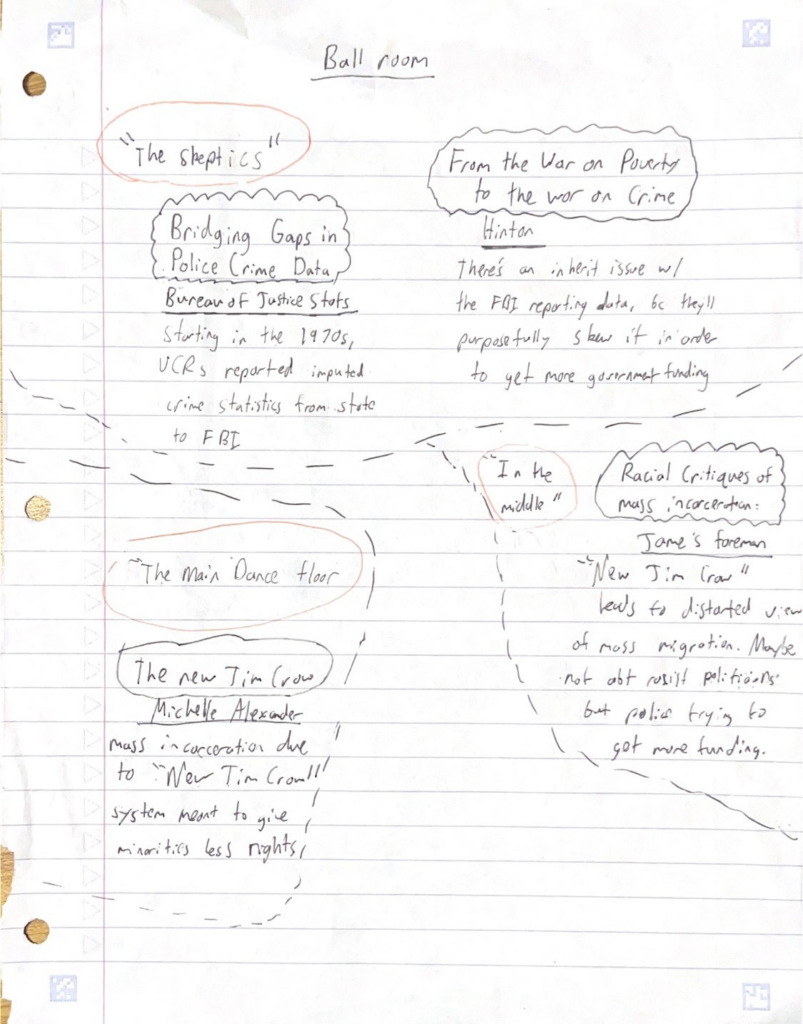
Progressing into the 1970s, The American Federal Bureau of Intelligence began collecting all crime data on a national level coincidentally at the same time violent crime statistics began skyrocketing. Scholars such as Elizabeth Hinton argue the FBI overinflate crime statistics to increase funding for federal police forces consequently increasing incarceration rates. So why do some scholars such as Michelle Alexander view the issue of mass incarceration as a plot to keep racism alive in America? The term “New Jim Crow” will be used heavily in this essay as an analogy to explain how the US Justice system disproportionately incarcerates minorities as a means of maintaining racial segregation. Alexander explains this by writing “… People who have been incarcerated rarely have difficulty identifying the parallels between these systems of control [US justice system and Jim crow]” (Alexander 5). Another key term is the UCR (Uniform Crime Report) which is a program that collects all crime statistical data across the nation onto one platform. Michael Maltz writes “in recent years more and more of the crime statistics reported by the police have not been based on crime counts but on imputed crime counts” (Maltz). So while Maltz sheds light on the fact that nationalized crime statistics were practically estimated starting in the 1970s, Hinton is theorizing based off this data that the FBI could be overinflating crime violent crime statistics to increase their funding. On the other hand, Michelle Alexander still asserts that mass incarceration is down to racist political agendas to keep incarcerated minorities without rights. To tie this conversation up, James Foreman agrees that as an analogy, “the New Jim Crow” is a powerful term to help with mass incarceration awareness but leads to a distorted view of the overall picture in all its context.

Ball Room Map Visualization:

PLEDGE: Robby Votta

Citations:

Alexander, Michelle. The New Jim Crow: Mass Incarceration in the Age of Colorblindness. 10th ed., New Press, 2020.

Forman, James Jr. “Racial Critiques of Mass Incarceration: Beyond the New Jim Crow.” Hein Online, Harvard Law School Library , 29 Nov. 2011,

Hinton, Elizabeth. “Introduction: Origins of Mass Incarceration” From the War on Poverty to the War on Crime, Edited by the Harvard University Press, 2016, pages 1-28

Maltz, Michael D. “Bridging Gaps in Police Crime Data – Bureau of Justice Statistics.” Bridging Gaps in Police Crime Data, Bureau of Justice Statistics, Sept. 1999, bjs.ojp.gov

Topic Proposal and Bibliography

Elizabeth Hinton sheds light on the fact that all crime statistics used in the debate over mass incarceration are provided by the US Federal Bureau of intelligence. Despite this, Hinton also claims these incarceration rate statistics are often distorted or wrong all together “because of their [law enforcement’s] own vested interests (Hinton 6). But what are the FBI and law enforcement’s “vested interests.” What do they have to gain by changing crime data? Are they overestimating or underestimating the issue of mass incarceration in America? Along with Elizabeth Hinton, Jeremy Travis, Bruce Western, and Steve Redburn have also written about mass incarceration, touching on how the FBI tends to alter crime stats in America. Angela Davis and Daniel Bell have also covered FBI crime statistics and the inner workings of how the FBI collects crime data and represents it to the public. By the end of my research, I hope to create a paper which helps the reader understands how the FBI relates to the issues of mass incarceration, and potential answers as to why their crime data can appear to be scewed.

PLEDGE: Robby Votta

Bibliography

Hinton, Elizabeth. “Introduction: Origins of Mass Incarceration” From the War on Poverty to the War on Crime, Edited by the Harvard University Press, 2016, pages 1-28

Western, Travis and Redburn.  “Chapter 5: The Crime Prevention Effects of Incarceration” Growth of Incarceration in the United States, Edited by Committee on Law and Justice on the National Research council, National Academies Press, 2014 pages 130-156

Davis, Angela “Are prisons Obsolete?” Edited by New York press, 2003

Bell, Daniel. “Bridging Gaps in Police Crime Data,” Bureau of Justice Statistics, September 1999, https://bjs.ojp.gov/

From the War of Poverty to the Wat on Crime SSB

Hinton Elizabeth, From the War on Poverty to the War on Crime (The Making of Mass Incarceration in America), Howard University Press, 2016

“But the extraordinary expansion of the urban police forces, court cases, and prison populations during the War on Drugs should be understood as the culmination of the domestic policies described in this book, rather than their beginning” (Hinton 4)

 Hinton wants the reader to focus on a more broad outlook on mass incarceration regarding the policies for funding of our criminal justice system with crime rates in urban, crime ridden areas.

Hinton hooks the reader in with a line of irony that even though incarceration rates have gone up, crime still increases. This can be seen as a crux and is linked to the thesis of this article. She provides historical context (essentially for the rest of the introduction but particularly here) about Lindon B. Johnson, and how his War on Poverty can be seen as the starting point to this crux Hinton wishes to solve. (1-2)

She emphasizes further, with evidence from Senator Strom Thurmond and the FBI that the government’s attempt to control crime only made the issue worse. An effective rhetorical strategy here is the use of sources from the very people she is discussing over to create strong, irrefutable evidence. It is explained that new policies with more funding going towards the police led to incentive to make incarcerations which could be a massive contributor to the issue. (2-7)

 Another crossroad is establishing where it is agreed upon by both conservative and liberal policy makers that mass incarceration must be prevented, yet there is a connection between right-leaning segregationists in office, and anti-crime legislation. She then uses this point to assert that the issue of mass incarceration must be fought primarily at a federal level to solve the issue nationwide. She then adds that there are many African American politicians in DC who advocate for a reformed criminal justice system that give way to American citizen activist protesting these policies. (7-9)

 Hinton then introduces The New Jim Crow by Michelle Alexander asserting that even though the book excels in discussing the book over a the 21st century, she will attempt to add more historical context in her own book. She hopes in doing so, she will broaden the discussion to fully understand the inner workings of how mass incarceration began. (10-11)

She continues with her historical context going back to the beginning of the war on poverty in the LBJ era and then builds into how this ultimately led to the war on crime/drugs. this is a power rhetorical strategy used as she first goes through the 60s to the present simply providing historical context, but now she is cycling back through what she already went over now focusing on how the war on poverty led to the war on crime which created this system of New Jim crow. She ensures that her readers follow along with each of her points and understand the cause and effect of late 20th century policy (11-18).

She wraps up her article with the “so what?” that she will be discussing in the rest of her book: the war on crime created a well funded police force in urban areas with the incentive of preventing crime, leading to racial division and mass incarceration of black people. She explains how later on she will reference how certain federal policies lead to violence in this nation and how she will analyze this system as a New Jim Crow. She concludes with the assertion that the Reagan war on drugs is primarily what led to this system of mass incarceration present day. (18-26)

James Foreman Jr.’s Racial Critiques of Mass Incarceration: Beyond The New Jim Crow (SSB)

Citation:

Forman, Jr. “Racial Critiques of Mass Incarceration: Beyond the New Jim Crow.” Hein Online, Harvard Law School Library , 29 Nov. 2011,

Thesis:

“The idea that the new Jim Crow analogy leads to a distorted view of mass incarceration- and therefore hampers our ability to challenge it effectively- is the central theme of this article.” (Forman 25)

            Foreman essentially wishes to argue in this article that even though she understands what the new Jim Crow analogy is attempting to accomplish, he sees some problems according to how the analogy views incarceration vs the original Jim Crow laws he wishes to address.

            The author hooks the reader in with historical context, introducing the shocking statistic that more African Americans are incarcerated today, than before the Brown v. Board of Education court case was in effect. She then defines how this represents the new Jim Crow and how scholars argue that the increase in black incarceration is to blame (exposition). He then creates a road map as to what will be discussed in the eight separate parts of his article.

            In part one of his article, he introduces who he will be responding to with much evidence. He will add to the conversation of William Buckman and John Lamberth who assert the new Jim Crow is present through our transportation system as well as the Ila Glasser with the ACLU for which they work for. In academia, she will respond to those in Temple University’s panel, U.S. Laws: the New Jim Crow as well as the book The New Jim Crow by Michelle Alexander. (25-27)

            In part two, Forman analyses the term “the New Jim Crow.” She analyzes how the two greatest consequences to overincarceration are the stripping away the rights of an increased number of African Americans who make it through the prison system as well as an increased stigma towards the African American community. She acknowledges that she understands why this analogy has been used as an effective way to illustrate the issues of Americas justice system. (27-34)

            In part three and four, he argues how the term obscures social aspects of the mass incarceration issue. He adds a crucial piece of evidence often overlooked by supporters of the New Jim Crow term, that crime skyrocketed at the same time as the dramatic increase in incarceration. Foreman argues that the term makes the issue seem like a systemic one when more effort should be investigated how we can decrease crime in lower income areas of the United States. He adds to this that a few areas like DC have black majority legislature that would in theory seek to counter this New Jim Crow but haven’t. He acknowledges that DC doesn’t necessarily represent how each state would handle the New Jim Crow but argues further that the term is rarely discussed in formal legislature. (34-45)

            In part five, he focuses specifically on how the War on Drugs relates to the new Jim crow. Foreman argues that supporter of the New Jim Crow looks specifically at the crime statics related to drug abuse, but not violent crimes. He shows evidence that most incarcerated people are in prison for violent crimes and property crimes, but few regarding the war om drugs. He analysis that focusing so exclusively on drug crimes takes from the credibility of the idea (45-52)

            In part six, Foreman makes a distinction between the old Jim Crow relating to everyone, versus the new Jim Crow relating primarily to the lower class. He wishes for the reader to consider the fact that the original Jim Crow applied to every black person equally whereas evidence shows that the new Jim Crow only applies to those in the lower class. He suggests that these issues may be down to economic inequality regarding in the classes rather that outright racism.  (52-58)

            In parts seven and eight, He looks at how the new Jim Crow takes away from the struggles of other racial groups as well as not affecting African Americans to the extent of original Jim Crow laws.  (58-64)

            Forman concludes by restating that he believes the new Jim Crow analogy is effective in getting people involved in the discussion of our broken prison systems and racial injustice. He believes there are still a few logical fallacies believers of the analogy need to iron out to make sound and trueful arguments. (64-end)

Essay 2: The Vienna Vignette

From romantic novels to traditional folk tales, we are conditioned in Western society to notice small side plots and expect them to fully resolve by the end of a story. So why does Mohsin Hamid defy this expectation in his 2017 novel Exit West? He sprinkles miniature side stories or vignettes throughout the book at random intervals, which never resurface. As a reader, I experienced a certain level of disappointment with the conclusion of the novel, as my expectation of the vignettes reappearing diminished. Supporters of this structure such as Nasia Anam assert Exit West’s unique style is effective because it presents the struggle between migrants and nativists separately from the primary plot. In contrast Yogita Goyal contends that Hamid’s approach is potentially unethical because it oversimplifies the current refugee crisis and removes the historical context needed to fully develop a sound discussion about migration. In this essay, I will examine how one vignette set in Vienna, Austria differentiates itself by connecting to the main plot and illustrating the brutal conflict between nativists and migrants today. I will argue that while Hamid’s Vienna vignette includes the necessary historical context for creating a realistic outlook of the refugee crisis, his overall execution of the story fails to fully represent the struggle between migrants and nativists in the real world.  

Investigating the vignettes’ structure and content can provide a greater understanding of how they relate to the novel. Each vignette occurs during a pause in the primary plot to describe interactions between unnamed migrants, who have walked through magical doors, and nativists. These magic doors transport migrants to another part of the world, creating a mass global migration to Western nations. Apart from the Vienna vignette, another example is the first vignette set in Sydney, Australia. This story includes imagery of a man “with dark skin and dark woolly hair” who walks through a magic door in the house of a “pale-skinned woman sleeping alone” (Hamid 9). Hamid attempts to avert the reader’s implicit racial bias that the man was there to harm the women when in fact, he intrudes by accident knowing “how little it took to make a man into meat: the wrong blow, the wrong gunshot, the wrong flick of a blade, turn of a car, presence of a microorganism in a cough” (Hamid 9). These vignettes, and the ones to follow, attempt to strengthen Hamid’s pro-immigration position by demonstrating how people cannot be judged by their outward appearance, but by the quality of their character.  

There are differing opinions as to the effectiveness of Hamid’s vignettes and whether they accurately portray the issues of migration. Nasia Anam argues that Exit West generates an optimistic outlook on a prosperous society despite mass migration to the West. She focuses on the nativist’s point of view, defining the concerns surrounding a migrant takeover of Western civilization as a dystopian future (Anam 656). Anam writes: “And so, it is more illuminating to consider the way the novel approaches the question of apocalypse: not as the end of civilization… rather the apocalypse becomes quotidian, arbitrary, manageable” (Anam 674). She sees this novel as a hopeful speculation into a future with complete homogenization of people and culture. Anam believes the novel rightfully assures readers that society has the capability to cooperate even when originating from separate cultures and nations “defusing the apocalypse” (Anam 674).  In contrast, Yogita Goyal does not endorse this sentiment, instead claiming that the vignettes oversimplify the complexities of migration for Western readers. She argues the vignettes only serve to reinforce the sentiment that cooperation can produce a unified world without borders, but they never confront the reality of today’s migration issues in their historical contexts. Goyal writes that “such asides smooth out all the rough edges of migration, superseding a conversation about the vast disparity in experiences of travel to simply insist on copresence in space and time” (Goyal 250). She argues the use of the magic doors in Exit West detaches readers from the complex politics involving migration across borders (Goyal 253). Building off Goyal’s argument I contend If Hamid intended to use fiction to speculate on our future, he has failed to create a future that would occur in our world.

The novel’s Vienna vignette deserves special attention. In the streets of Vienna, an unnamed woman witnesses a massacre by a military force resulting from migration into the city from the magic doors. The story discusses necessary historical context by noting that while the conflict was chaotic, it did not compare to the world wars of the 20th century (Hamid 110). Additionally, the vignette successfully decentralizes the main characters by creating a scene which illustrates the grievances between nativists and migrants, helping the reader understand the scale to which the magic doors changed society. The story also stands alone in being the only vignette relating to the primary plot when the main characters read about the Vienna riots in the newspaper. The vignette concludes when the fighting stops at the climax of civil unrest, making the conclusion seem like fantasy to me (Hamid 111). I see this strain of events to be as fictional as the magic doors themselves. In a real-world scenario, extreme fighting would ensue between nativists, who wish to protect their homeland, and migrants seeking a better life. Goyal correctly argues that the novel is too detached from modern global migration issues and attempts to force an unrealistic narrative in which we could all get along if we simply set our differences aside.  

In conclusion, the Vienna vignette fills the role of coming full circle with the main plot but fails in creating a valid argument for Hamid pertaining to a speculative peace in a borderless world. This is a fictional novel revolving primarily around a love interest which is perhaps intended to be just that. Despite this, the novel still features heavy topics surrounding immigration which a western reader with little knowledge of the complexities of migration can interpret as an assertation that society would continue to run, conflict free, in a borderless world. Exit West readers must be mindful of how the novel’s vignettes explore migration at a surface level, but not on a world-changing one. 

Citations:

Anam, Nasia “The Migrant as Colonist: Dystopia and Apocalypse in the Literature of Mass Migration,” Published by Johns Hopkins University, Press ASAP/Journal, Volume 3, Number 3, September 2018, pp. 653-677 (Article)

Goyal, Yogita, “We Are All Migrants”: The refugee Novel and the Claims of Universalism, Johns Hopkins University Press, Vol. 66, No. 2, Summer 2020, pp. 239-259 (Article)  

Hamid, Mohsin. Exit West. Penguin, 2017.

Honor Code Pledge:

On my honor I have neither given nor received unauthorized information regarding this work, I have followed and will continue to observe all regulations regarding it, and I am unaware of any violation of the Honor Code by others.

Pear review comments:

From Nikita

Robby,
Your essay effectively sets up a conversation between Anam and Goyal, focusing on why Mohsin Hamid “murders” vignettes and almost never mentions them again. I like how you portrayed the uniqueness of the “Austrian” vignette, highlighting that it is the only vignette mentioned one more time.
While your essay demonstrates a good understanding of Anam’s and Goyals’ arguments, it lacks a deeper dive into them. After reading your essay, I didn’t understand how their arguments support or weaken your vignette research. Moreover, in the end, I expected that you would answer the first question of your essay(1), but I didn’t catch it; instead, I saw overgeneralization without enough evidence to support it.
The ways to improve are to state your thesis clearly in the first paragraph, use specific quotes from the book to strengthen your argument, improve the structure of your essay, and reduce passive voice.

1) “So why does Mohsin Hamid break this inclination in his 2017 novel Exit West?”

Secondary Source Blue Print: The New Jim Crow (introduction)

Citation:

Alexander, Michelle. The New Jim Crow: Mass Incarceration in the Age of Colorblindness. 10th ed., New Press, 2020.

 “A new consensus must be forged about race and the role of race in defining the basic structure of our society if we hope ever to abolish the new Jim Crow. This new consensus must begin with dialogue, a conversation that fosters a critical consciousness, a key prerequisite to effective social action. This book is an attempt to ensure that the conversation does not end with nervous laughter.” (Alexander 19)

Alexander has found through her career that the prison system in America is being used as a new form of Jim Crow Laws hidden from the media. She hopes that with this novel, she can show the reader how this is a real issue that must be taken seriously. She argues that standard political work will not solve the problem, but instead, the knowledge of the existence of the “New Jim Crow.”

The reader is hooked in with a story by Jarvious Cotton, and how he and his ancestors were all discriminated in different ways. While his forbearers were stripped of rights under slave laws and later Jim Crow, Jarvious was stripped of his rights by going through the racially discriminating court system. She develops her crux that even though racial segregation is banned in law, it is still present with our justice system as a conduit. (1-2)

Alexander then opens with her critical debate where she will primarily be responding to those who believe our justice system is being used to employ racial discrimination as a conspiracy theory. She also explains how she used to be one of these people before she started investigating the US justice system as a lawyer. (2-5)

She continues her argument by discussing 1980s drug wars to provide context as to how this New Jim Crow got off the ground in the first place. She explains the theoretical foundations of how drugs were implanted in impoverished black communities to increase crime rates on purpose to implement racial discrimination through incarceration. She also  adds a line as to how Barak Obama’s presidency does not mark the end of racism in this country, and instead, blinds some people to the racism that still exists.  (5-10)

Alexander provides even more evidence and analysis to her discussion by exposing the rapid increase in incarceration rates over the previous decades. She hopes to shock the readers into understanding the extent to which this crisis existence. She then offers another crux, pointing to how people involved in the discussion search most aspects of our political system for the reasons behind increased in racial inequality, but our prison system is primarily unmentioned. She advocates a push to decrease incarceration rates by halting the construction and investment of new prison systems and juvenile detention centers instead, focusing on disbanding racial inequality in our nation. Lastly, she elevates her conversation by drawing a comparison to other western European incarceration rates to demonstrate how the US is an outlier in the issue as far as the western world is concerned. (10-14)

She continues to define “caste system” a term she will use throughout the book referring to the rights of those post incarceration vs people who have stayed clear of US prisons. She uses the term caste system, because the higher percentage of black and brown prisoners who reenter the world are theoretically left with fewer rights than thus, a synthesis of systemic racism is created. She also defines the term “mass incarceration” which she uses frequently referring only to the US criminal justice system and in no other context. (14-18)

               Alexander concludes her introduction by once again stating that the primary purpose of her book is to normalize the conversation of US mass incarceration of minorities in hopes the conversation will trickle its way into modern politics. She additionally points out that she cannot possibly cover all aspects of the problem in her one book, so instead she will hyperfocus on specific issues from which she has studied carefully and analyzed (19-20)

Key Word Map

Help, V.

  1. to preform work for another who is unable (red)

    “capital punishment means ‘them without the capital get the punishment.’ We can’t help people on death row without help from people like you.” (pg. 10)

    2. To make a task easier for another (blue)

      “We’re working on getting you a lawyer, a real lawyer, and we
      hope the lawyer will be down to see you in the next few months. I’m
      just a law student. I’m really happy to help, I mean, if there’s
      something I can do.” (pg. 13)

      3. To carry out a minor action for another deserving of little gratitude (green)

      “All day long people have been asking me, ‘What can I do to help
      you?’ When I woke up this morning, they kept coming to me, ‘Can
      we get you some breakfast?’ At midday they came to me, ‘Can we
      get you some lunch?’ All day long, ‘What can we do to help you?’


      This evening, ‘What do you want for your meal, how can we help
      you?’ ‘Do you need stamps for your letters?’ ‘Do you want water?’
      ‘Do you want coffee?’ ‘Can we get you the phone?’ ‘How can we
      help you?’ ” (pg. 93)

      These three different definitions of “help” quantifies the levels of how the word can be used in the context of the book. In Herbert’s case, the guards treat him horribly right up to the day of his death penalty, when all of a sudden, they begin to feel guilty and shameful for their actions. But it’s too late for apologies or closure, so instead they simply ask to help him in the smallest most meaningless ways possible. This contrasts with the help Stevenson gives, as he takes on multiple death row cases, working all day long to give his clients the best opportunities he can, with little pay.

      citations:

      “Just Mercy A Story of Justice and Redemption.” Just Mercy A Story of Justice and Redemption.Pdf, https://www.cardozohigh.com/, 1 June 2022, www.cardozohigh.com/ourpages/auto/2022/6/1/46834297/Title – Just Mercy A Story of Justice and Redemption.pdf.
      used to find each use of the word “help” in the novel. (Pages cited from pdf)

      Honor Code Pledge:

      On my honor I have neither given nor received unauthorized information regarding this work, I have followed and will continue to observe all regulations regarding it, and I am unaware of any violation of the Honor Code by others.